يذكر عن عمرو بن شعيب عن أبيه عن جده قال: قال رسول الله ـ صلى الله عليه وسلم ـ: إذا رأيتم الحريق فكبروا، فإن التكبير يطفئه
Narrated by Amr Bin Shuaib Radi Allaho Anh, on authority of his father (& grandfather) that Prophet Muhammad Sallallaho Alaihe Wasallam said: "Whenever you see the FIRE, say Takbeer (Allah oAkbar), because Takbeer extinguishes the fire".
Burns are usually caused by fire, which is the substance from which the devil was created, and this is why the devil finds it befitting his nature and the evil that he seeks to achieve. Therefore, the devil helps the fire to cause harm. Fire usually seeks domination and devastation. These two matters, domination & devastation are the guidance of the devil that he calls to and with which he leads mankind to destruction. Fire & the devil both seek domination & affliction, while Allah's Pride Intervenes by extinguishing these evils and the acts of devil.
This is why praising Allah that He is the Greatest has a profound effect on extinguishing the fire, for Allah's Greatness overwhelms anything and everything. When a Muslim praises Allah's Greatness, this supplication will cause the fire and efforts of devil (Sheytaan) to fade away and thus fire will be extinguished. We have used this method & found it to be perfectly true.
Carlyle
was a man of genius and God gifted him with the art of articulation.
In his own way, he wanted to putthe records straight. He planned
to deliver a lecture and he chose a very provocative topic "The
hero asProphet."
and he chose this hero-prophet to be the most maligned man of his
time, "MUHAMMAD (PBUH)!"Not Moses, David, Solomon, or
Jesus but Muhammad!To placate his overwhelming
Anglican (belonging to the Church of England) fellow countrymen, he
apologised - "AS THERE IS NO DANGER OF OURBECOMING, ANY OF US,
MAHOMETANS, I MEAN TO SAY ALL THE GOOD OF HIM I JUSTLY CAN."
In
other words he, as well as his elite audience were free from the fear
of converting to Islam, and could takea chance in paying some
compliments to Muhammad (pbuh). If he had any fears regarding the
strength oftheir
faith, he would not have taken that chance. In an era of hatred and
spite towards everything Islamic andto an audience full of scepticism
and cynicism, Carlyle unfolded many a glowing truth about his hero -Muhammad (pbuh) "To the
praise-worthy," indeed be praise.
For that is what the very
name Muhammadmeans
- the Praised One - the Praiseworthy. There are times when Carlyle
uses words and expressions,which might not be too pleasing
to the believing Muslim, but one has to forgive him as he was walking
acultural
tightrope, and he succeeded eminently. He Paid our hero many ardent
and enthusiastic tribute, anddefended him from the false
charges and calumnies of his enemies, exactly as the Prophet had done
in thecase
of Jesus (pbuh) and his mother.
II.
Prophet Muhammad (pbuh) Prophesised in Atharvaveda
In the 20th book of Atharvaveda Hymn 127 Some Suktas (chapters) are known as
Kuntap Sukta. Kuntap means the consumer of misery and troubles. Thus meaning
the message of peace and safety and if translated in Arabic means Islam.
Kuntap also means hidden glands in the abdomen. These mantras are called so
probably because their true meaning was hidden and was to be revealed in
future. Its hidden meaning is also connected with the navel or the middle point
of this earth. Makkah is called the Ummul Qur’a the mother of the towns or the
naval of the earth. In many revealed books it was the first house of Divine
worship where God Almighty gave spiritual nourishment to the world. The Qur’an
says in Surah Ali-Imran chapter 3, verse 96:
"The first house (of worship) appointed for men was that at Bakkah
(Makkah) full of blessings and of guidance and for all kinds of beings".
Thus Kuntap stands for Makkah or Bakkah.
Several people have translated these Kuntap Suktas like M. Bloomfield, Prof.
Ralph Griffith, Pandit Rajaram, Pandit Khem Karan, etc.
The main points mentioned in the Kuntap Suktas i.e. in Atharvaveda book 20 Hymn
127 verses 1-13 are:
Mantra 1
He is Narashansah or the praised one (Muhammad). He is Kaurama: the prince of
peace or the emigrant, who is safe, even amongst a host of 60,090 enemies.
Mantra 2
He is a camel-riding Rishi, whose chariot touches the heaven.
Mantra 3
He is Mamah Rishi who is given a hundred gold coins, ten chaplets (necklaces),
three hundred good steeds and ten thousand cows.
Mantra 4
Vachyesv rebh. ‘Oh! ye who glorifies’.
The Sanskrit word Narashansah means ‘the praised one’, which is the literal
translation of the Arabic word Muhammad (pbuh).
The Sanskrit word Kaurama means ‘one who spreads and promotes peace’. The holy
Prophet was the ‘Prince of Peace’ and he preached equality of human kind and
universal brotherhood. Kaurama also means an emigrant. The Prophet migrated
from Makkah to Madinah and was thus also an Emigrant.
He will be protected from 60,090 enemies, which was the population of Makkah.
The Prophet would ride a camel. This clearly indicates that it cannot be an
Indian Rishi, since it is forbidden for a Brahman to ride a camel according to
the Sacred Books of the East, volume 25, Laws of Manu pg. 472. According to
Manu Smirti chapter 11 verse 202, "A Brahman is prohibited from riding a
camel or an ass and to bathe naked. He should purify himself by suppressing his
breath".
This mantra gave the Rishi's name as Mamah. No rishi in India or another
Prophet had this name Mamah which is derived from Mah which means to esteem
highly, or to revere, to exalt, etc. Some Sanskrit books give the Prophet’s
name as ‘Mohammad’, but this word according to Sanskrit grammar can also be
used in the bad sense. It is incorrect to apply grammar to an Arabic word.
Actually it has the same meaning and somewhat similar pronunciation as the word
Muhammad (pbuh).
He is given 100 gold coins, which refers to the believers and the earlier
companions of the Prophet during his turbulent Makkan life. Later on due to
persecution they migrated from Makkah to Abysinia. Later when Prophet migrated
to Madinah all of them joined him in Madinah.
The 10 chaplets or necklaces were the 10 best companions of the Prophet
(pbuh) known as Ashra-Mubbashshira (10 bestowed with good news). These were
foretold in this world of their salvation in the hereafter i.e. they were given
the good news of entering paradise by the Prophet’s own lips and after naming
each one he said "in Paradise". They were Abu Bakr, Umar, Uthman,
Ali, Talha, Zubair, Abdur Rahman Ibn Auf, Saad bin Abi Waqqas, Saad bin Zaid
and Abu Ubaidah (May Allah be well-pleased with all of them).
The Sanskrit word Go is derived from Gaw which means ‘to go to war’. A cow is
also called Go and is a symbol of war as well as peace. The 10,000 cows refer
to the 10,000 companions who accompanied the Prophet (pbuh) when he entered
Makkah during Fateh Makkah which was a unique victory in the history of mankind
in which there was no blood shed. The 10,000 companions were pious and
compassionate like cows and were at the same time strong and fierce and are
described in the Holy Quran in Surah Fatah:
"Muhammad is the Messenger of Allah; and those who are with him are strong
against unbelievers, (but) compassionate amongst each other." [Al-Qur'an 48:29]
This mantra calls the Prophet as Rebh which means one who praises, which when
translated into Arabic is Ahmed, which is another name for the Prophet
(pbuh).
Battle of the Allies described in the Vedas.
It is mentioned in Atharvaveda Book XX Hymn 21 verse 6, "Lord of the
truthful! These liberators drink these feats of bravery and the inspiring songs
gladdened thee in the field of battle. When thou renders vanquished without
fight the ten thousand opponents of the praying one, the adoring one."
This Prophecy of the Veda describes the well-known battle of Ahzab or the
battle of the Allies during the time of Prophet Muhammed. The Prophet was
victorious without an actual conflict which is mentioned in the Qur’an in Surah
Ahzab:
"When the believers saw the confederate forces they said, "This is
what Allah and His Messenger had promised us and Allah and His Messenger told
us what was true." And it only added to their faith and their zeal in
obedience." [Al-Qur'an 33:22]
The Sanskrit word karo in the Mantra means the ‘praying one’ which when
translated into Arabic means ‘Ahmed’, the second name of Prophet Muhammed
(pbuh).
The 10,000 opponents mentioned in the Mantra were the enemies of the Prophet
and the Muslims were only 3000 in number.
The last words of the Mantra aprati ni bashayah means the defeat was given to
the enemies without an actual fight. The enemies’ defeat in the conquest of Makkah is mentioned in
Atharvaveda book 20 Hymn 21 verse no 9:
"You have O Indra, overthrown 20 kings and 60,099 men with an outstripping
Chariot wheel who came to fight the praised one or far famed (Muhammad)
orphan."
The population of Makkah at the time of Prophet’s advent was nearly 60,000
There were several clans in Makkah each having its own chief. Totally there
were about 20 chiefs to rule the population of Makkah.
An Abandhu meaning a helpless man who was far-famed and ‘praised one’. Muhammad
(pbuh) overcame his enemies with the help of God.
III. Muhammad (pbuh) prophesised in the Rigveda
A similar prophecy is also found in Rigveda Book I, Hymn 53 verse 9:
The Sanskrit word used is Sushrama, which means praiseworthy or well praised
which in Arabic means Muhammad (pbuh).
IV. Muhummad (pbuh) is also prophesised in the Samveda
Prophet
Muhammad (pbuh) is also prophesised in the Samveda Book II Hymn 6 verse 8: "Ahmed acquired from his Lord the knowledge of eternal law. I received
light from him just as from the sun." The Prophecy confirms:
The name of the Prophet as Ahmed since Ahmed is an Arabic name. Many
translators misunderstood it to be Ahm at hi and translated the mantra as
"I alone have acquired the real wisdom of my father".
Prophet was given eternal law, i.e. the Shariah.
The Rishi was enlightened by the Shariah of Prophet Muhammad. The Qur’an says
in Surah Saba chapter 34 verse 28
"We have not sent thee but as a universal (Messenger) to men, giving them
glad tidings and warning them (against sin), but most men understand not." [Al-Qur'an 34:28]
1.
Common Concept of God in Hinduism:
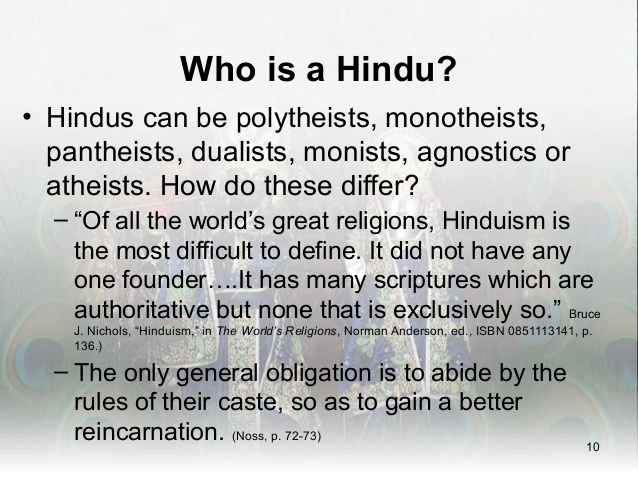
Hinduism is commonly perceived as a polytheistic religion. Indeed, most Hindus
would attest to this, by professing belief in multiple Gods. While some Hindus
believe in the existence of three gods, some believe in thousands of gods, and
some others in thirty three crore i.e. 330 million Gods. However, learned
Hindus, who are well versed in their scriptures, insist that a Hindu should
believe in and worship only one God.
The major difference between the Hindu and the Muslim perception of God is the
common Hindus’ belief in the philosophy of Pantheism. Pantheism considers
everything, living and non-living, to be Divine and Sacred. The common Hindu,
therefore, considers everything as God. He considers the trees as God, the sun
as God, the moon as God, the monkey as God, the snake as God and even human
beings as manifestations of God!
Islam, on the contrary, exhorts man to consider himself and his surroundings as
examples of Divine Creation rather than as divinity itself. Muslims therefore
believe that everything is God’s i.e. the word ‘God’ with an apostrophe ‘s’. In
other words the Muslims believe that everything belongs to God.
The
trees belong to God, the sun belongs to God, the moon belongs to God, the
monkey belongs to God, the snake belongs to God, the human beings belong to God
and everything in this universe belongs to God.
Thus the
major difference between the Hindu and the Muslim beliefs is the difference of
the apostrophe ‘s’. The Hindu says everything is God. The Muslim says
everything is God’s.
2. Concept of God according to
Hindu Scriptures:
We can gain a better understanding of the concept of God in Hinduism by
analysing Hindu scriptures.
BHAGAVAD GITA:
The most popular amongst all the Hindu scriptures is the Bhagavad Gita.
Consider the following verse from the Gita:
"Those whose intelligence has been stolen by material desires surrender
unto demigods and follow the particular rules and regulations of worship
according to their own natures." [Bhagavad Gita 7:20]
The Gita states that people who are materialistic worship demigods i.e. ‘gods’
besides the True God.
UPANISHADS:
The Upanishads are considered sacred scriptures by the Hindus.
The following verses from the Upanishads refer to the Concept of God:
1. "Ekam evadvitiyam"
"He is One only without a second."
[Chandogya Upanishad 6:2:1] [The Principal Upanishad by S. Radhakrishnan page 447 and 448]
[Sacred Books of the East, volume 1 ‘The Upanishads part I’ page 93]
2.
"Na casya kascij janita na cadhipah."
"Of Him there are neither parents nor lord."
[Svetasvatara Upanishad 6:9] [The Principal Upanishad by S. Radhakrishnan page 745]
[Sacred Books of the East, volume 15, ‘The Upanishads part II’ page 263.]
3.
"Na tasya pratima asti"
"There is no likeness of Him."
[Svetasvatara Upanishad 4:19] [The Principal Upanishad by S. Radhakrishnan page 736 & 737]
[Sacred Books of the East, volume 15, ‘The Upanishads part II’ page no 253]
4.
The following verses from the Upanishad allude to the inability of man to
imagine God in a particular form:
"Na samdrse tisthati rupam asya, na caksusa pasyati kas canainam."
"His form is not to be seen; no one sees Him with the eye."
[Svetasvatara Upanishad 4:20] [The Principal Upanishad by S. Radhakrishnan page 737]
[Sacred Books of the East, volume 15, ‘The Upanishads part II’ page no 253]
THE VEDAS
Vedas are considered the most sacred of all the Hindu scriptures. There are
four principal Vedas: Rigveda, Yajurveda, Samveda and Atharvaveda.
1.
Yajurveda
The following verses from the Yajurveda echo a similar concept of God:
1. "na tasya pratima asti"
"There is no image of Him."
[Yajurveda 32:3] [Yajurveda by Devi Chand M.A. page 377]
2.
"shudhama poapvidham"
"He is bodyless and pure."
[Yajurveda 40:8] [Yajurveda
Samhita by Ralph T. H. Giffith page 538]
3.
"Andhatama pravishanti ye asambhuti mupaste"
"They enter darkness, those who worship the natural elements" (Air,
Water, Fire, etc.). "They sink deeper in darkness, those who worship
sambhuti."
[Yajurveda 40:9] [Yajurveda Samhita by Ralph T. H. Giffith page 538]
4. Sambhuti means created things, for example table, chair, idol, etc.
The Yajurveda contains the following prayer:
"Lead us to the good path and remove the sin that makes us stray and
wander."
[Yajurveda 40:16] [Yajurveda Samhita by Ralph T. H. Griffith page 541]
2. Atharvaveda
The Atharvaveda praises God in Book 20, hymn 58 and verse 3:
"Dev maha osi"
"God is verily great"
[Atharvaveda 20:58:3] [Atharveda
Samhita vol 2 William Dwight Whitney page 910] 3. Rigveda
1. The oldest of all the vedas is Rigveda. It is also the one considered
most sacred by the Hindus. The Rigveda states in Book 1, hymn 164 and verse 46: "Sages (learned
Priests) call one God by many names."
[Rigveda 1:164:46]
2. The
Rigveda gives several different attributes to Almighty God. Many of these are
mentioned in Rigveda Book 2 hymn 1.
Among the various attributes of God, one of the beautiful attributes mentioned
in the Rigveda Book II hymn 1 verse 3, is Brahma. Brahma means ‘The Creator’.
Translated into Arabic it means Khaaliq. Muslims can have no objection if
Almighty God is referred to as Khaaliq or ‘Creator’ or Brahma. However if it is
said that Brahma is Almighty God who has four heads with each head having a
crown, Muslims take strong exception to it.
Describing Almighty God in anthropomorphic terms also goes against the
following verse of Yajurveda:
"Na tasya Pratima asti" "There is no image of Him."
[Yajurveda 32:3]
Another beautiful attribute of God mentioned in the Rigveda Book II hymn 1
verse 3 is Vishnu. Vishnu means ‘The Sustainer’. Translated into Arabic it
means Rabb. Again, Muslims can have no objection if Almighty God is referred to
as Rabb or 'Sustainer' or Vishnu.
But the
popular image of Vishnu among Hindus, is that of a God who has four arms, with
one of the right arms holding the Chakra, i.e. a disc us and one of the left
arms holding a ‘conch shell’, or riding a bird or reclining on a snake couch.
Muslims can never accept any image of God. As mentioned earlier this also goes
against Svetasvatara Upanishad Chapter 4 verse 19.
"Na tasya pratima asti"
"There is no likeness of Him"
The following verse from the Rigveda Book 8, hymn 1, verse 1 refer to the Unity
and Glory of the Supreme Being:
3.
"Ma cid anyad vi sansata sakhayo ma rishanyata"
"O friends, do not worship anybody but Him, the Divine One. Praise Him
alone."
[Rigveda 8:1:1] [Rigveda Samhita vol. 9, pages 2810 and 2811 by Swami Satya Prakash Sarasvati
and Satyakam Vidyalankar]
4. "Devasya samituk parishtutih"
"Verily, great is the glory of the Divine Creator."
[Rigveda 5:1:81] [Rigveda Samhita vol. 6, pages 1802 and 1803 by Swami Satya Prakash Saraswati
and Satyakam Vidyalankar]